
úterý 25. března 2014
Studia Neoaristotelica 2013-3
České číslo studií je online a brzy by mělo dorazit i do schránek (a snad i do nějakých knihkupectví). Studia mají nově i své Facebookové stránky, což znamená, že je možné mj. i diskutovat online o jednotlivých příspěvcích. Příspěvky vytváří hezkou dějovou linii: tradiční Scotova metafyzika, náročná středověká logika, překvapivá scholasticka mystika, Kantův praktický skepticismus a nakonec úvaha nad počátky toho všeho.

neděle 23. března 2014
Anglie 21: konec první části stáže na Universitě v Readingu
Dnes mi končí první část stáže na Universitě Reading. Mým prvním, skromným, pracovním cílem bylo nastudovat si podrobněji knihu Real Essentialism (2007) Davida Oderberga, který zde přednáší. Zároveň zde mám příležitost chodit na jeho doktorandský seminář (a k tomu jsem si ještě přidal pro zlepšení svých znalostí bakalářský seminář a přednášky Further logic od Alice Drewery). Oderbergova kniha je vynikající obhajobou tradičního pojetí esence jakožto reálného "jádra" jednotlivých věcí, zakládajícího jejich podstatu a identitu (srv. 09.06.2010). (Zde tuto tezi samozřejmě mohu ponechat jen na intuitivní úrovni - je mi zřejmé, že termíny jako je "jádro", "podstata", "zakládat", atd. jsou vágní a mnohoznačné; v naší nové knize Neoaristotelian Perspectives vysvětluje a hájí tradiční pojetí esence Michael Gorman; podle mého názoru je jeho kapitola momentálně tím nejlepším stručným objasněním a obhajobou tohoto pojetí).
Oderberg se nezdržuje historií, ale věnuje se polemikám se současnými autory a v kontextu současných vědeckých poznatků. (V mnoha jednotlivých detailech by sice hlubší znalost historie přispěla, jenže nelze zpracovat historii i systematiku do stejné hloubky, kniha má své priority a parametry). Knihu recenzovalo několik současných špičkových metafyziků (Armstrong, Feser, Lowe).
Shrnutí: Real Essentialism is an essential reading on essence from Reading

Kniha má deset kapitol, první tři obecnějšího rázu, poslední tři "aplikované", zde je její obsah:
Oderberg se nezdržuje historií, ale věnuje se polemikám se současnými autory a v kontextu současných vědeckých poznatků. (V mnoha jednotlivých detailech by sice hlubší znalost historie přispěla, jenže nelze zpracovat historii i systematiku do stejné hloubky, kniha má své priority a parametry). Knihu recenzovalo několik současných špičkových metafyziků (Armstrong, Feser, Lowe).
Shrnutí: Real Essentialism is an essential reading on essence from Reading
Kniha má deset kapitol, první tři obecnějšího rázu, poslední tři "aplikované", zde je její obsah:
1. Současný esencialismus a reálný esencialismus
1.1. Proti modalismu: možné světy
1.2. Proti modalismu: Fineova kritika
1.3 Redukcionismus: iluzorní hledání vnitřní struktury
1.4 Proč reálný esencialismus?
2. Některé druhy anti-esencialismu
2.1. Empiricistický anti-esencialismus
2.2 Quineovy výtky
2.3. Popper: vyhýbavost před „co je to?“ otázkami
2.4 Wittenstein: stín gramatiky
3. Realita a poznatelnost esencí
3.1 Proč jsou esence reálné
3.2 „Problém“ univerzálních akcidentů
3.3 Empirický test pro esence?
3.4 Cesty k poznání esence
3.5 „Paradigmata“, „steretypy“ a klasifikace
4. Struktura esence
4.1 Hylemorfismus: akt a potence
4.2. Substanciální forma
4.3. První látka
4.4. Substance
4.5. Imanence esence
5. Esence a identita
5.1 Reálná definice a pravý zákon identity
5.2 Porfyrovský strom
5.3 The Analogy of Being
5.4 Individuace
5.5 Identity over time
6. Esence a existence
6.1 Reálná distinkce v kontingentních jsoucnech
6.2. Vše je kontingentní ... téměř
6.3 Schopnosti (powers)
6.4 Zákony přírody
7. Aspekty esence
7.1 Druhy akcidentů
7.2 Podstata vlastností
7.3 Poznání esencí skrze vlastnosti
7.4 Artefakty
7.5 Původ a konstituce
8. Život
8.1 Esence života
8.2 Druhy organismů
8.3 Proti emergenci
9. Druhy, biologické a metafyzické
9.1 Je biologický esencialismus mrtvý?
9.2 Proti kladistickému pojmu druhu
9.3 Vágnost
9.4 A plea for morphology
10. Osoby
10.1 Esence osoby
10.2 Hylemorfický dualismus
10.3 Vědomí, psychologie a osoba
10.4 Forma, tělo a duše
10.5 Duše, intelekt, a imaterialita
10.6 Duše, identita, a materiálné závislost
10.1 Esence osoby
10.2 Hylemorfický dualismus
10.3 Vědomí, psychologie a osoba
10.4 Forma, tělo a duše
10.5 Duše, intelekt, a imaterialita
10.6 Duše, identita, a materiálné závislost
pondělí 27. ledna 2014
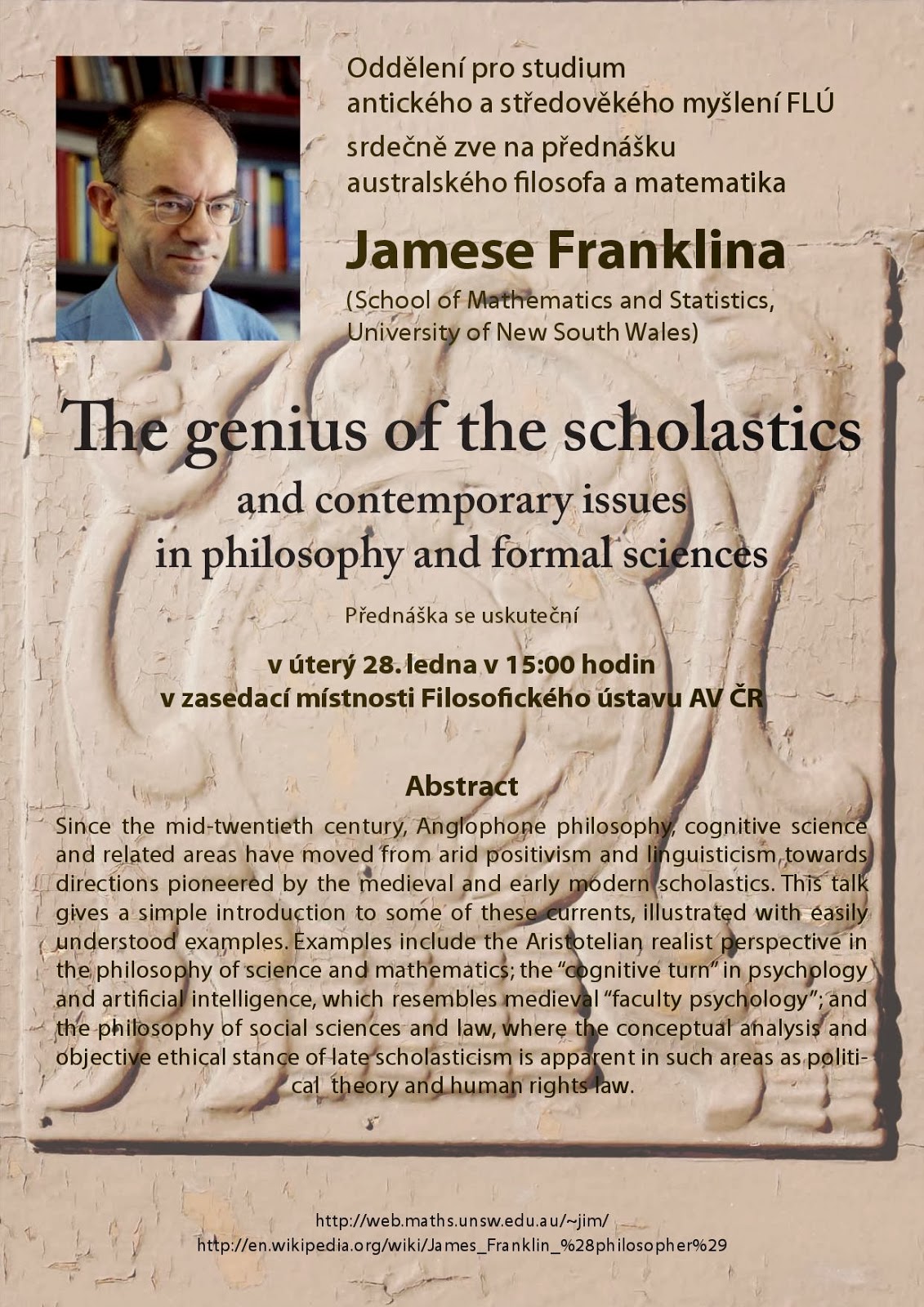
Franklin v Praze
Brilantní australský filosof a matematik, James Franklin, bude zítra na návštěvě v Praze (srv. 01.07.2011). Kromě této populárněji zaměřené přednášky bude pro naši skupinu "Analytické teologie" mít ve čtvrtek i workshop na FÚ (téma: pravděpodobnost).
středa 8. ledna 2014
E. J. Lowe (1950 - 2014) - R. I. P
Včera ke mně (díky Vlastovi Vohánkovi) dorazila smutná zpráva o smrti jednoho z nejvýznamnějších současných neoaristotelských metafyziků, E. J. Lowa (1950-2014), o jehož zdravotních potížích jsem věděl, ale netušil jejich závažnost. Zpráva se mě osobně dotkla, třebaže jsem se s prof. Lowem ("Jonathanem") setkal osobně jen dvakrát a byli jsme jen ve sporadickém emailovém kontaktu. Plně potrvzuji níže zmíněný obětavý a pokorný přístup k lidem a k filosofii, jež byl pro prof. Lowa charakteristický. Velmi si vážím si toho, že nám prof. Lowe ještě nedávno zaslal svůj příspěvek pro nadcházející knihu Neoaristotelian Perspectives in Metaphysics.
It is with great sadness that we announce the death of Professor E. J. (Jonathan) Lowe. Jonathan was born in Dover, England, on 24th March 1950. He went to Cambridge to read Natural Sciences in 1968, but changed to History after one year and was awarded a BA (first class) in 1971. After that, he switched to Philosophy and moved to Oxford, where he was awarded his BPhil and DPhil degrees in 1974 and 1975 (supervised by Rom Harré and Simon Blackburn respectively). After a brief period teaching at Reading, Jonathan joined the Department of Philosophy at Durham in 1980, where he stayed for the rest of his career. He was promoted to Senior Lecturer (1990), Reader (1992) and then Professor (1995). During his time at Durham, Jonathan established himself as one of the world’s leading philosophers, publishing twelve single-authored books, four co-edited collections and well over 200 articles in journals and edited volumes. His scholarship was strikingly broad, ranging from early modern philosophy through to the interpretation of quantum mechanics. His most important and sustained contributions were to philosophy of mind, philosophical logic and especially metaphysics.
Jonathan adopted a realist conception of metaphysics as an autonomous discipline concerned with the fundamental structure of reality, as exemplified by his important book The Possibility of Metaphysics (OUP, 1998). Metaphysics, he maintained, should take common sense as its starting point, while at the same time acknowledging that aspects of common sense will need to be revised or abandoned. It should also retain a healthy respect for science but resist scientism, as the role of metaphysics is to illuminate features of reality that empirical scientific enquiry inevitably presupposes. It is therefore the most fundamental form of enquiry and - as Jonathan also emphasised – something that is extremely difficult to do. But, he insisted, there are no cheap short-cuts, and no piecemeal solutions to metaphysical problems. Metaphysics is to be done systematically and patiently. Jonathan’s approach drew inspiration from Aristotle and Locke, amongst others, both of whom retained a foothold in common sense. His metaphysical writings addressed a range of themes, including volition, personhood, agency, mental causation, identity, truth, essentialism and ontological categories. In recent years, one of his many notable achievements was the formulation of a new ‘four-category ontology’, which he proposed as a metaphysical foundation for all empirical scientific thought. The most detailed account of this appears in his book The Four-Category Ontology (OUP, 2006).
Throughout his life, Jonathan was guided by a kind of faith in our ability to discover the fundamental structure of reality through metaphysical thought. He was spurred on by a constant sense of puzzlement, fascination and bewilderment at the existence and nature of reality, and would not let extraneous considerations distract him from a resolute search for truth. Those of us who knew him will remember him not just as a gifted and committed philosopher but also as an exceptionally kind, caring and generous person. He was an accomplished teacher, who did everything he possibly could to support, encourage, nurture and inspire his students, many of whom have gone on to have successful academic careers. He was similarly supportive of his colleagues at Durham and of the wider philosophical community. Philosophers from all over the world came to depend on him as a mentor and referee, and he would spend many hours most weeks writing carefully crafted letters of support. It was a privilege to work with Jonathan. He was always a keen participant in research events, at Durham and elsewhere, where he exercised his astonishingly refined critical skills and offered numerous insightful comments, without ever being dismissive. Even with his eminence in the profession and the many associated demands on his time, he insisted on doing his fair share (and usually more than his fair share) of administrative and teaching work. He was a reassuring presence in the department, who was always on hand to offer support, advice and consolation to colleagues. We are diminished by the loss of an outstanding philosopher and a great friend.
Jonathan died on 5th January 2014, after several months of illness. He leaves his wife, Susan, and their two adult children, Rebecca and Tim.
(Robin Hendry and Matthew Ratcliffe, 7th January 2014)
Zde jsou poznámky od jeho finského studenta, taktéž metafyzika, Tuomase Tahko.
Aktualizace 11.02.2014: Vzpomínky na Lowa od Davida S. Oderberga.
úterý 31. prosince 2013
Vánoce a Nový rok 2014
Různá krásná a vtipná přání jsem letos s vděčností obdržel (sám líný své vlastní tvořit), zde je přání "vítězné".


pondělí 2. prosince 2013
Feser (2013): Aristotle on Method a Metaphysics
S určitým zpožděním jsem si všiml, že Ed Feser vydal nedávno další zajímavou knihu, přispívající k současnému oživení aristotelsko-scholastické tradice (srv. např. Contemporary Aristotelian Metaphysics, 30.11.2012).

Feser v úvodu zmiňuje knihu Metaphysics: Aristotelian, Scholastic, Analytic, kterou jsme s kolegy editovali v r. 2012. Obzvláště se těším na příspěvek Oderbergův, hájících neredukovatelnost živých organismů a Feserův, diskutujících aplikaci aristotelismu na Newtonovskou a Einsteinovskou fyziku. Feserova kniha je zakotevena výrazněji v historickém aristotelském bádání, čímž se liší od naší připravované knihy, která pojímá neoaristotelismus volněji a zaměřuje se výrazněji na metafyziku.

Feser v úvodu zmiňuje knihu Metaphysics: Aristotelian, Scholastic, Analytic, kterou jsme s kolegy editovali v r. 2012. Obzvláště se těším na příspěvek Oderbergův, hájících neredukovatelnost živých organismů a Feserův, diskutujících aplikaci aristotelismu na Newtonovskou a Einsteinovskou fyziku. Feserova kniha je zakotevena výrazněji v historickém aristotelském bádání, čímž se liší od naší připravované knihy, která pojímá neoaristotelismus volněji a zaměřuje se výrazněji na metafyziku.
čtvrtek 28. listopadu 2013

Přihlásit se k odběru:
Příspěvky (Atom)

